Sapphire - Radeon Rx 580 8gb Nitro+ Special Edition Video Card Review
At a Glance
Proficient's Rating
Pros
- Great 1080p, practiced 1440p, and solid VR gameplay
- Compelling price to functioning
- Sapphire's Nitro+ customizations await and piece of work great
Cons
- Lags far behind GTX 1060 in power efficiency
- Basically a rebrand of the RX 480 with slightly higher clock speeds
Our Verdict
The Radeon RX 580 is basically the Radeon RX 480 with a new name, only that still makes it the best mainstream graphics card around. Sapphire's custom Nitro+ design is stellar.
Best Prices Today

$229.99
When AMD'southward Radeon RX 480 launched just under a year ago, it redefined what was possible with a $200 graphics card, delivering uncompromising 1080p gaming, darn good 1440p performance, and fifty-fifty the power to play VR games—none of which was ever available in a graphics card that affordable before.
But it wasn't quite a flawless victory, and not but considering Nvidia'southward comparable (however pricier) GeForce GTX 1060 launched before long later on. The Radeon RX 480 suffered from a power-describe controversy that AMD fixed with admirable speed. Stocks of the carte du jour were limited for months, which led to inflated pricing and endless ache in enthusiast forums. The 4GB Radeon RX 480 was hands-down the best "sweetness spot" graphics card you could purchase, but information technology had some baggage in Google searches.
Enter the Radeon RX 580, announced today as part of AMD'southward mild Radeon RX 500-series refresh.
The Radeon RX 580 release sweeps away all of that controversy—and gives AMD new Radeon 500-serial GPUs to sell alongside its new Ryzen 5 processors. Only these "new" graphics cards aren't really new at all, relying on the same underlying graphics processors as the RX 480, but with slightly boosted clock speeds granted by a year of process optimizations. With so piffling inverse, and Nvidia's GeForce GTX 1060 besides matured, is AMD'due south offer however the mainstream graphics carte champion?
Allow'south discover out.
Come across the Radeon RX 580
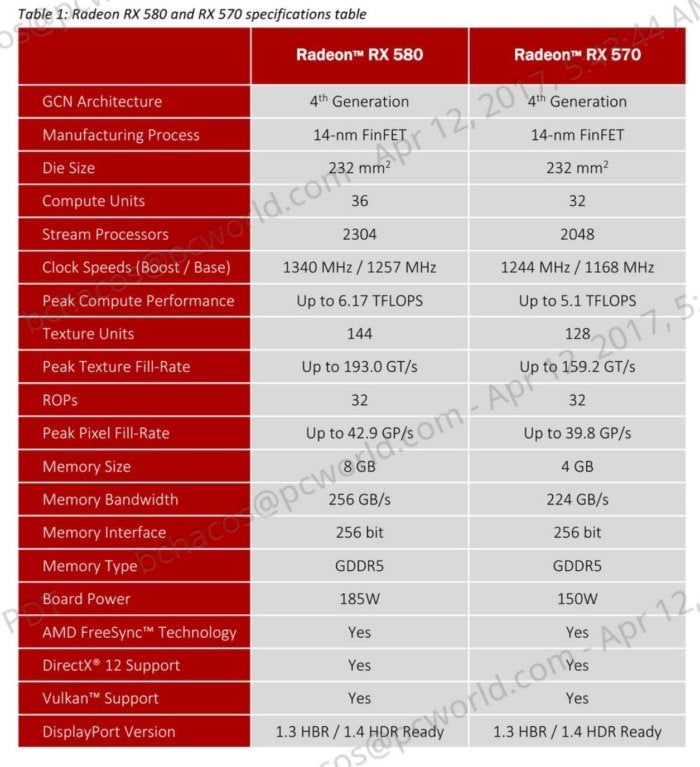
Here'due south a look at the reference specs for the Radeon RX 580 and RX 570 (which PCWorld also reviewed). Even though the chart says the RX 570 packs 4GB of retentiveness and the RX 580 has 8GB, that's just AMD's recommendation. Both cards volition be offered in both capacities.
 AMD
AMD AMD'southward Radeon RX 570 and RX 580 tech specs.
At that place'south not much deviation from the RX 480, honestly. You'll find minor bumps to top compute speeds and memory bandwidth, but the just major tweak is the RX 580's clock speed. AMD's up to the 2d generation of optimizations on the Polaris architecture, which let the company bump the speeds upwardly from the RX 480'due south i,120MHz base and 1,266MHz boost clocks to 1,257MHz/1,340MHz on the Radeon RX 580. The Radeon RX 580'southward base clock is at present effectively the same as the RX 480's boost clock. Pretty nifty, though in that location's unfortunately no bump tomemory speeds or capacity.
Cranking clocks requires cranking ability, though. The Radeon RX 580 is rated for a 185W TDP, compared to the RX 480's 150W, so expect the cards to need an viii-pin power supply. AMD's likewise allowing board makers to build cards with both an 8-pin and a 6-pin ability connectors to push things even further.
 AMD
AMD Radeon Chill now supportsLeague of Legends andDota two.
AMD's offsetting that power increase with the introduction of a new power country that reduces free energy usage when you're idle, using multiple monitors, or watching videos. The company'due south also stressing the tremendous power- and temperature-savings of Radeon Chill, a wonderful characteristic introduced in Radeon Cerise ReLive. Arctic'due south disabled by default, though, and only compatible with nineteen games—though they're 19 of the most-played games around, and coinciding with the Radeon RX 500-series reveal, AMD also announced that Dota 2 and League of Legends at present piece of work with Chill.
The company won't release a reference version of the Radeon RX 580 though. Instead, all of the cards that hit the streets—today—will be customized models by AMD hardware partners similar Sapphire, XFX, PowerColor, et cetera.
 Brad Chacos/IDG
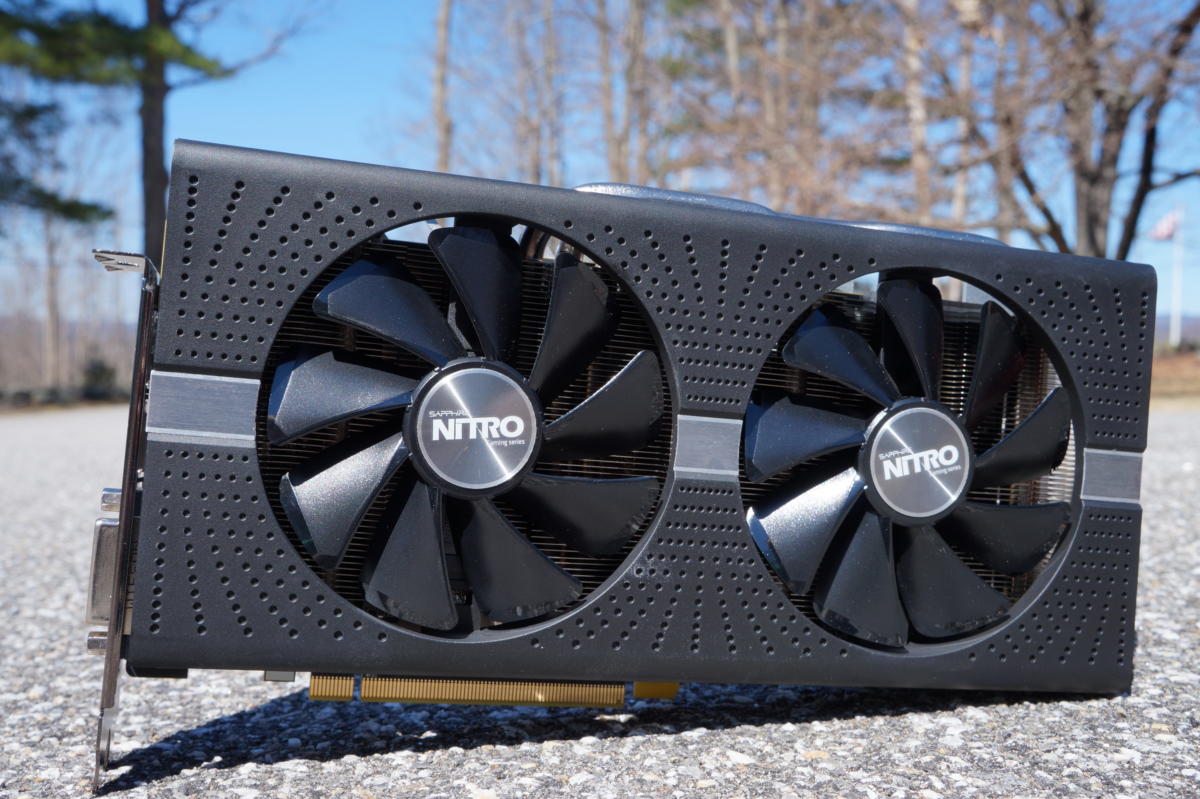
 The Sapphire Radeon RX 580 Nitro+.
Speaking of which, the card we're reviewing today is the 8GB Sapphire RX 580 Nitro+ ($250 on Newegg), which cranks clock speeds all the mode upwardly to 1,411MHz, or 69MHz faster than Sapphire's older RX 480 Nitro+.
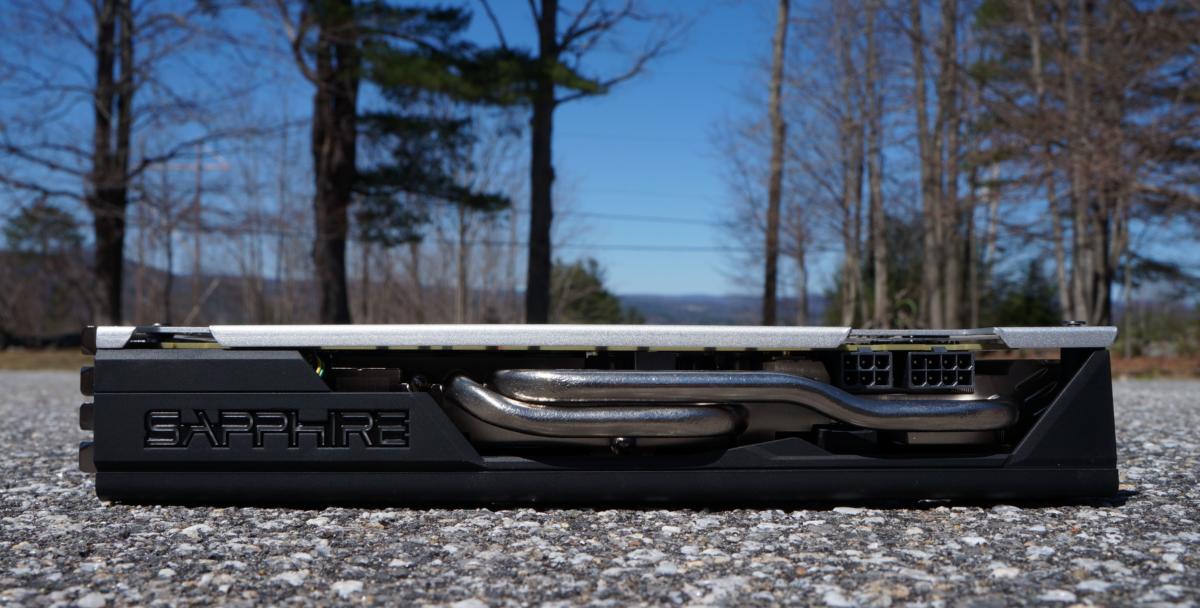
Merely it can go even farther! While the older card relied on a single viii-pivot power connector, the Sapphire RX 580 Nitro+ adds an optional half dozen-pin connector to the mix, so the board can provide plenty of juice if you lot wind upward winning the silicon lottery with a GPU that overclocks like a champ. That's augmented past Sapphire'due south black diamond chokes, which filter and clean upwardly the menu'south electrical signals.
 Brad Chacos/IDG
 Sapphire'southward RX 580 needs two power connections.
The Sapphire RX 580 Nitro+ maintains a tweaked version of the superb Dual-X cooling system from its predecessor. That'southward fine by us. Dual-Ten's dual fans and heat pipe-infused oestrus sink piece of work well—as you'll encounter in the temperatures section—and Sapphire has re-engineered the cooler's design to run much quieter than earlier. Plus, the look of Sapphire's menu remains stunning.
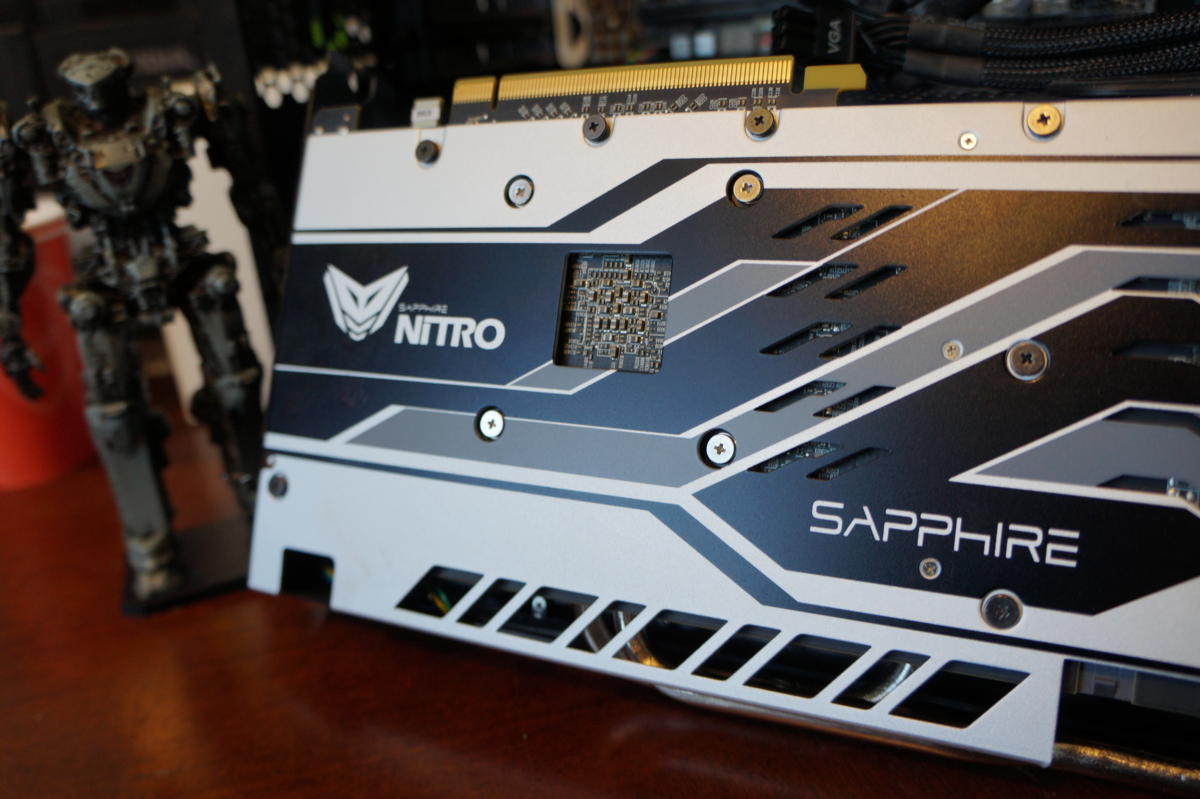
While many modern graphics cards rock bright colors, angular designs, and RGB everything that cater to the edgy so-called "gamer" artful, the RX 580 Nitro+ sticks to sleek silver-and-blackness simplicity that looks great in our GPU testing system. The Sapphire logo on the side still lights upward, merely in a tasteful blue hue by default (you lot can manually change the color with Sapphire's Trixx utility). The perforated black shroud looks elegant despite existence difficult plastic, particularly paired with the Nitro+'south gorgeous (and redesigned) metal backplate.
 Brad Chacos/IDG
 That's one pretty backplate.
The Sapphire RX 580 Nitro+'due south fans won't first spinning until y'all toss a decently heavy graphics load at your PC. They're also held in past a single screw for easy replacement in case of failure—no demand to send your entire GPU back. Sapphire's aforementioned Trixx software even includes a Fan Health characteristic that, uh, checks the health of your fans and tin connect y'all with Sapphire support if one craps out.
 Brad Chacos/IDG
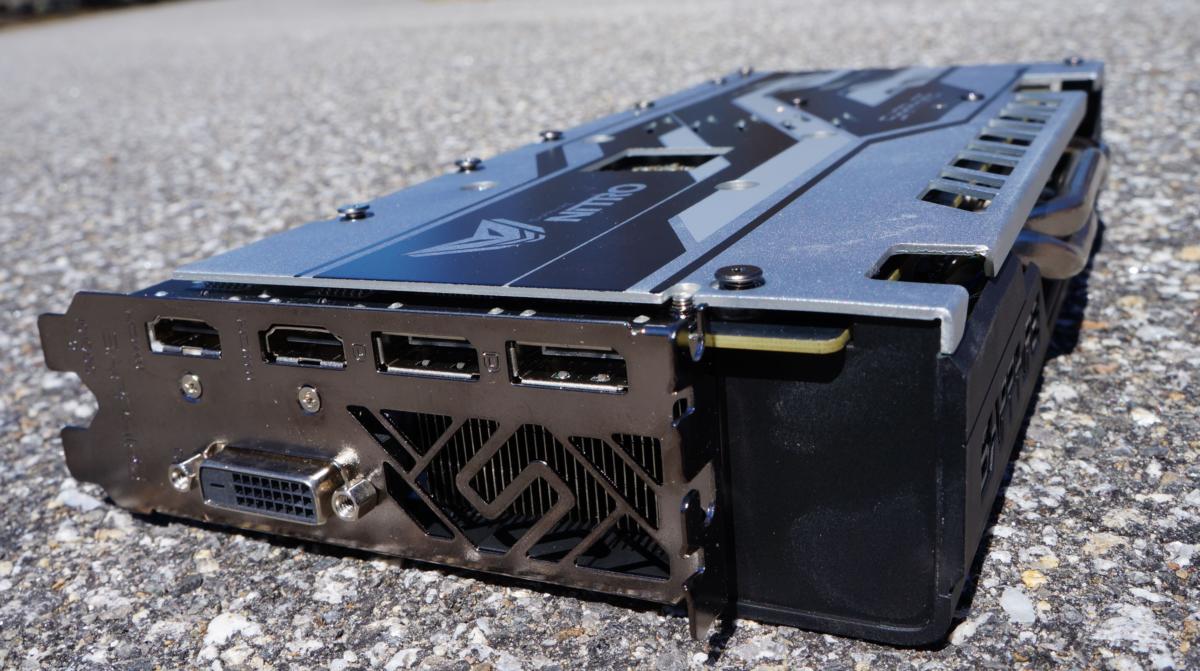
 Finally, the Nitro+ includes dual DisplayPorts, two HDMI two.0 connections, and DVI-D. The DVI port will be a approval for folks with older monitors, while the pair of HDMI ports should come in handy for early virtual-reality adopters, as the Oculus Rift and HTC Vive each utilise an HDMI connection.
Enough talk. Let's benchmark!
Next page: Exam organisation configuration, benchmarks begin
Our exam system/Sectionalization results
We tested Sapphire'due south Radeon RX 580 Nitro+ on PCWorld's defended graphics card criterion system. Our testbed's loaded with loftier-end components to avoid bottlenecks in other parts of the system and evidence unfettered graphics operation.
- Intel'south Core i7-5960X with a Corsair Hydro Series H100i closed-loop water cooler ($120 on Amazon).
- An Asus X99 Deluxe motherboard ($230 on Amazon for an updated version).
- Corsair's Vengeance LPX DDR4 retention ($130 on Amazon), and 1,200-watt AX1200i power supply ($310 on Amazon).
- A 480GB Intel 730 series SSD ($280 on Amazon).
- Phanteks' Enthoo Evolv ATX case ($190 on Amazon).
- Windows ten Pro ($158 on Amazon).
Nosotros're comparing the $250 Sapphire Radeon RX 580 Nitro+ against its natural competitors. Since this is an overclocked model, it'll get upwards confronting an overclocked RX 480—MSI's ferocious 8GB Gaming 10, specifically. We also tested EVGA's overclocked 6GB GeForce GTX 1060 SSC ($250 on Amazon) and stock-clocked 3GB GeForce GTX 1060 ($190 on Amazon), as well equally Gigabyte'southward overclocked $180 Aorus RX 570 to show how the RX 580'due south little brother holds up.
AMD's marketing materials compare the RX 580 to the older R9 380 and GTX 970, pushing the "upgrade with Ryzen" bending, but we're not going to do that here. Frankly, the RX 480 already outpunched those cards, as covered in PCWorld's year-one-time RX 480 review—specially the older Radeon.
Each game's tested using its in-game benchmark at the mentioned graphics presets, with V-sync, frame-rate caps, and all GPU vendor-specific technologies—like AMD TressFX, Nvidia GameWorks options, and FreeSync/G-Sync—disabled.
The Division
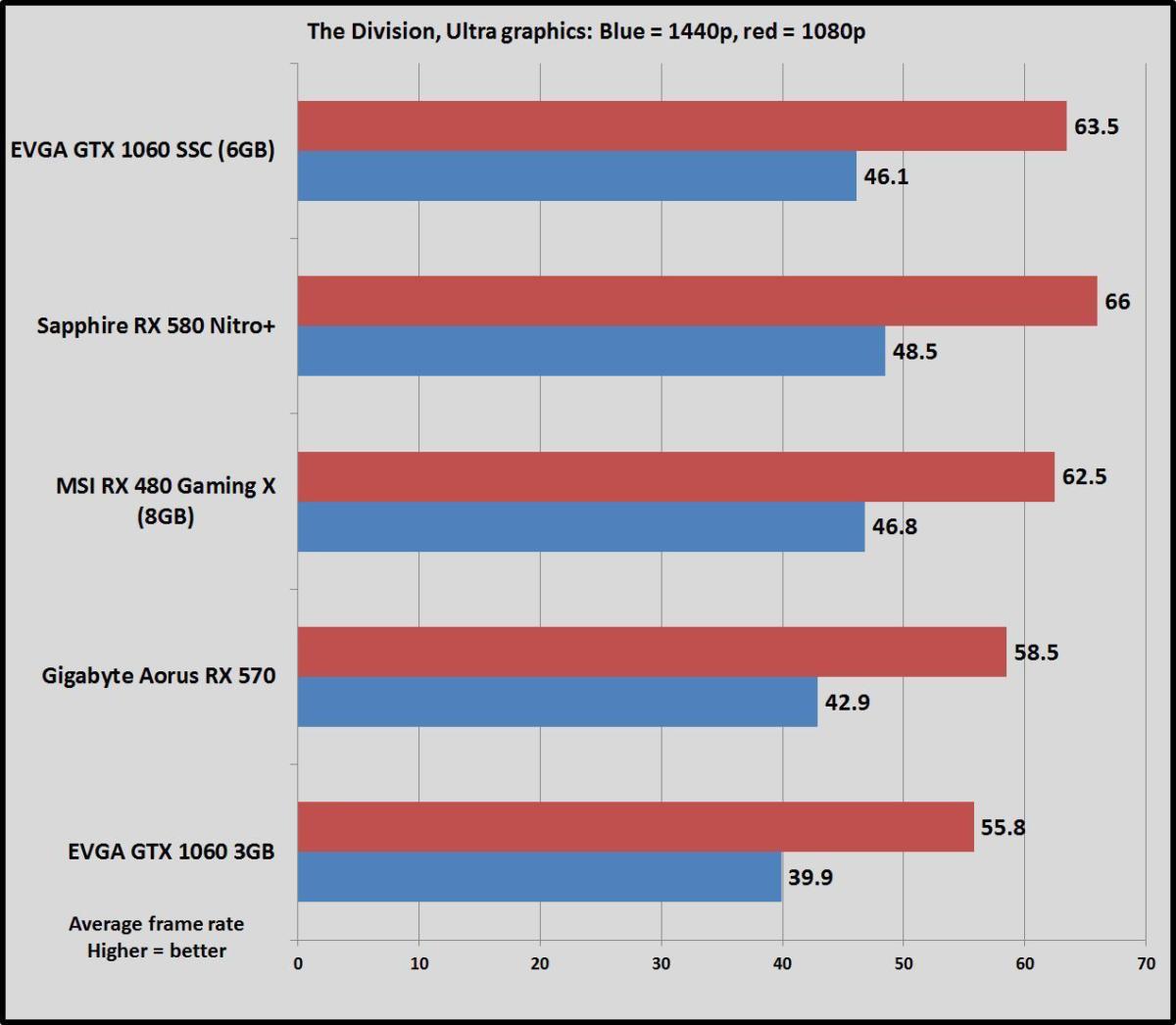
The Division, a gorgeous third-person shooter/RPG that mixes elements ofDestinyandGears of War, kicks things off with Ubisoft's new Snowdrop engine. We test the game in DirectX eleven manner; The Division recently rolled out an update that adds DirectX 12 support, only the operation is nearly identical to the DX11 results.
 Brad Chacos/IDG
 The overclocked EVGA GTX 1060 and MSI RX 480 cards deliver virtually identical performance hither. The Sapphire RX 580 Nitro's bolstered clock speeds eke out a few extra frames but it's a pretty minor increase. The roughly xiii pct lead the RX 580 maintains over the RX 570 is enough to firmly push it past 60fps at 1080p, and deliver a noticeably smoother 1440p feel. There's a big divergence betwixt frame rates in the lower- and upper-40s.
Side by side page: Hitman
Hitman
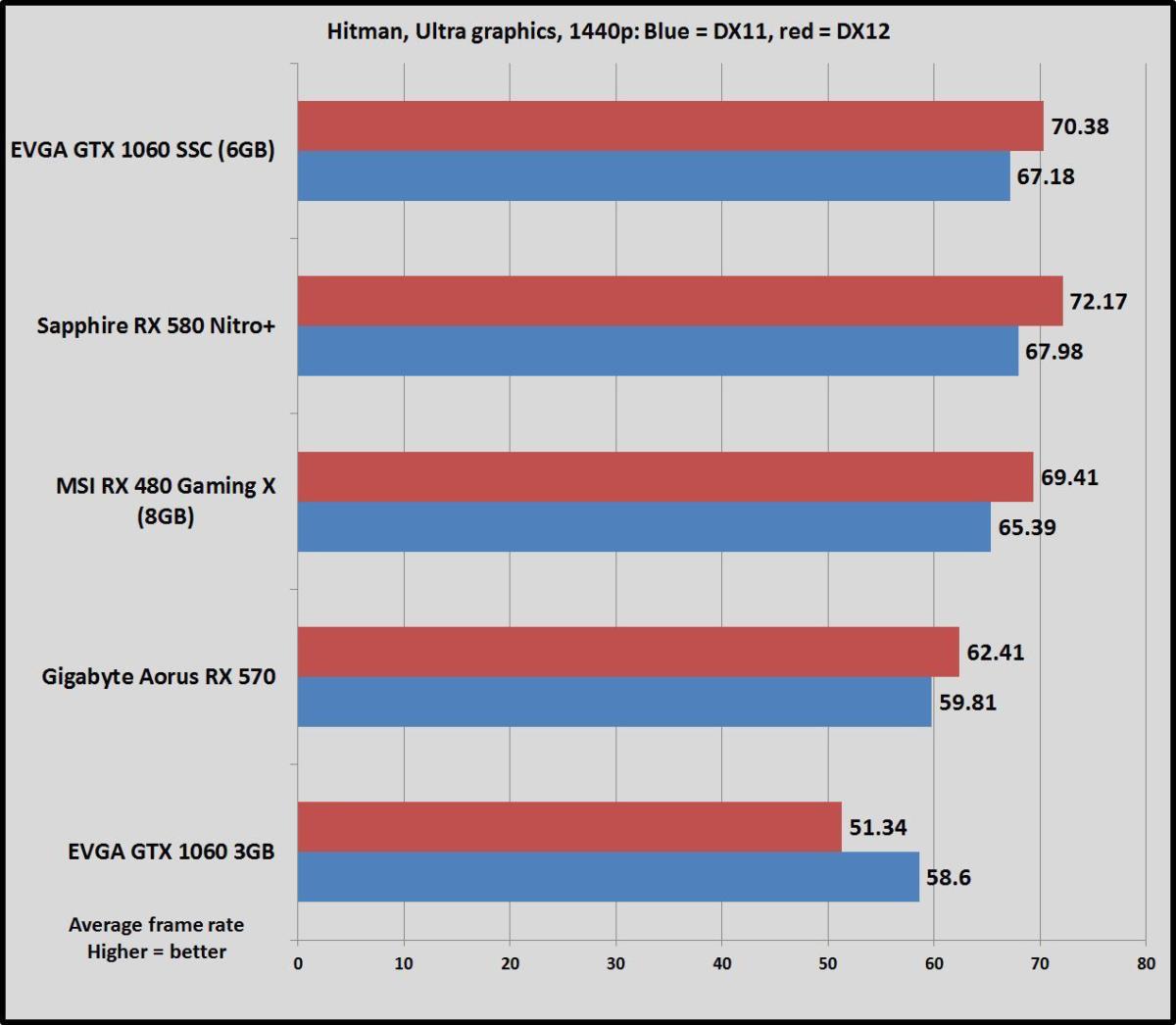
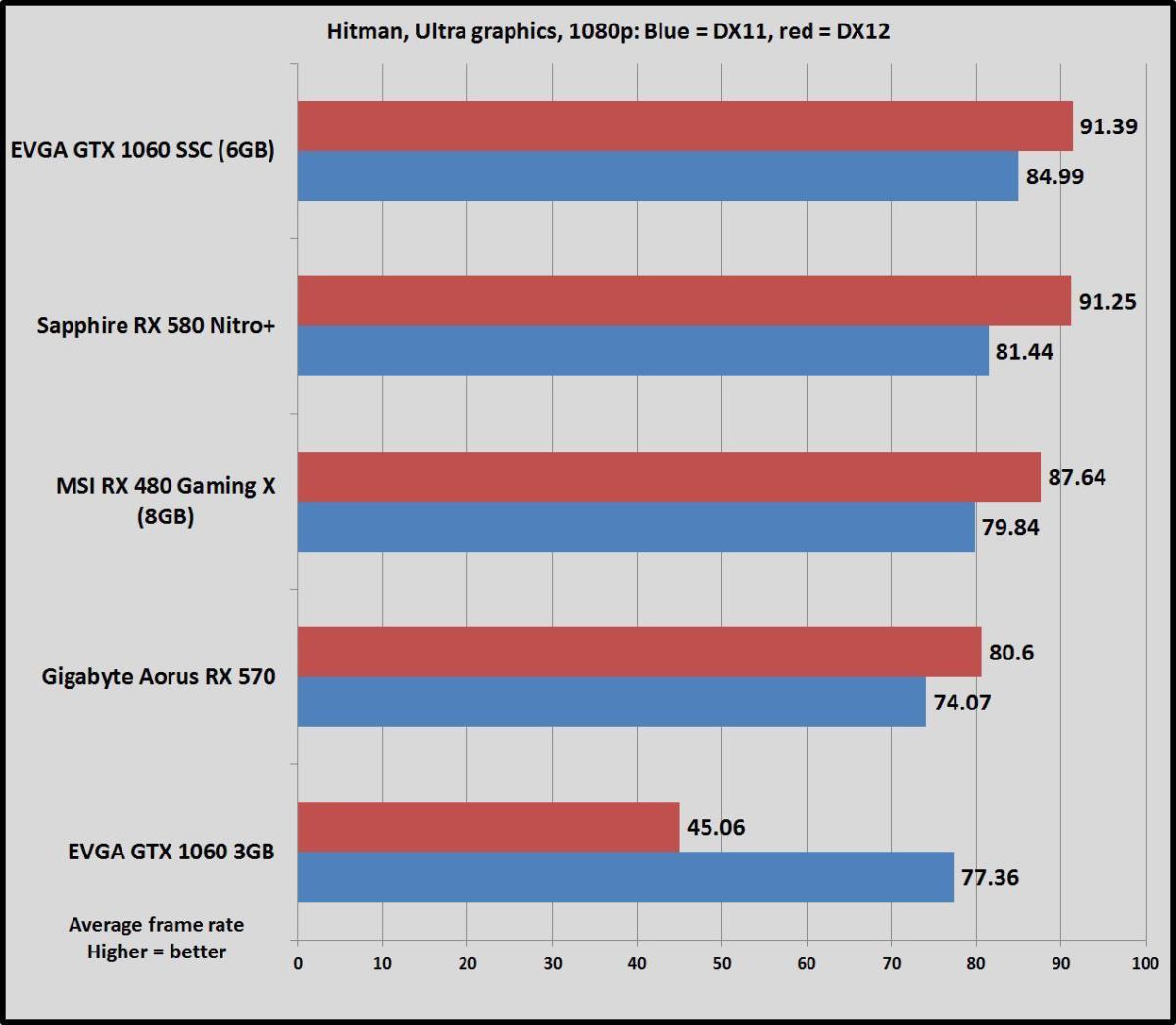
Hitman's Glacier engine historically favored AMD hardware. It's no surprise;Hitman's a flagship AMD Gaming Evolved title. That said, GeForce cards certainly don't slouch after recent driver optimizations. We test in both DirectX 11 and DirectX 12 with SSAO disabled.
 Brad Chacos/IDG
  Brad Chacos/IDG
 The Radeon RX 580 Nitro+ once again delivers a mere few frames-per-2nd increase compared to its predecessor, and a sizable atomic number 82 over the RX 570, though it draws adequately even with the overclocked 6GB GTX 1060.
Aside from the RX 580's paltry performance uptick, the virtually noticeable thing here is the 3GB GTX 1060'due south DirectX 12 functioning. DX12 tends to striking retention pretty difficult, and it shows in cards with less than 4GB of RAM. EVGA's 3GB card stutters heavily when you flip the DX12 switch, which in plow drags downwardly its overall frame rate.
Next page: Ascent of the Tomb Raider
Rise of the Tomb Raider
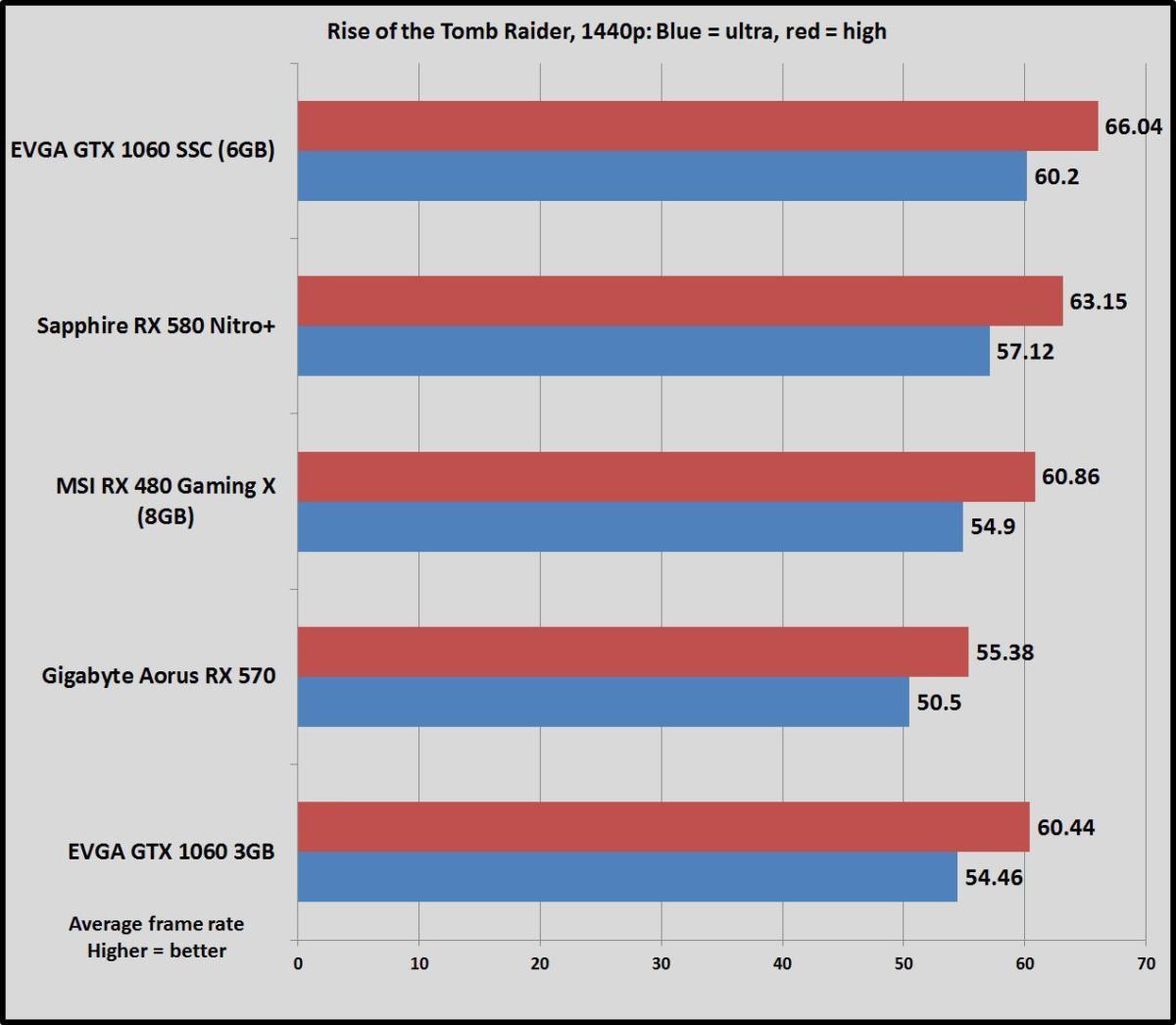
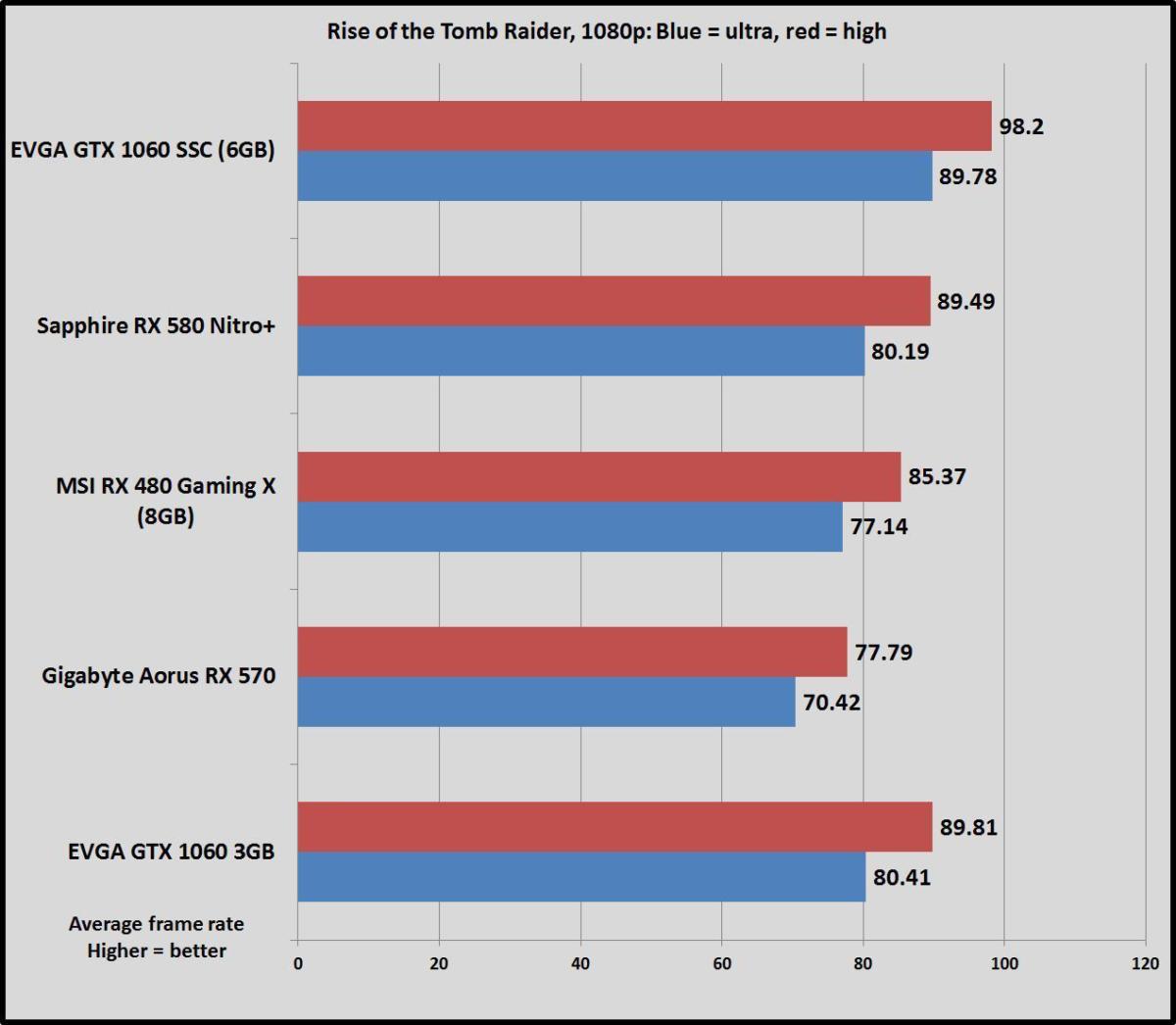
WhereasHitmanadores Radeon GPUs,Rise of the Tomb Raiderperforms much improve on GeForce cards—and it's absolutely gorgeous. We only examination the game'southward DirectX eleven fashion, as DX12 results can be erratic.
 Brad Chacos/IDG
  Brad Chacos/IDG
 The Sapphire RX 580 Nitro+'southward extra oomph helps it close the gap on Nvidia's contender hither, particularly at 1440p resolution, which flirts with the 60fps aureate standard—dissimilar the Aorus RX 570. The gulf widens at 1080p but that'due south to be expected with this game.
Side by side page: Far Cry Primal
Far Cry Fundamental
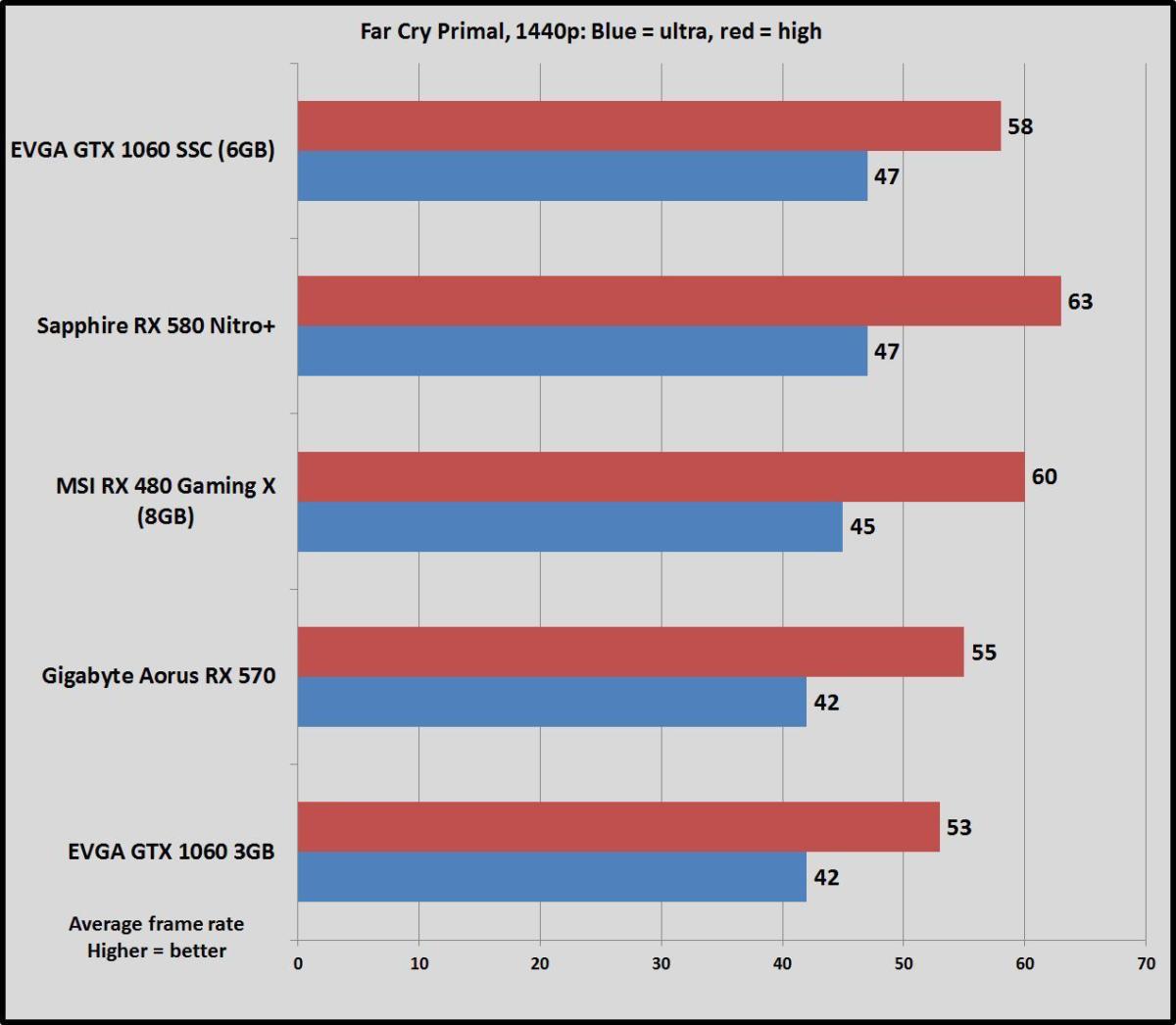
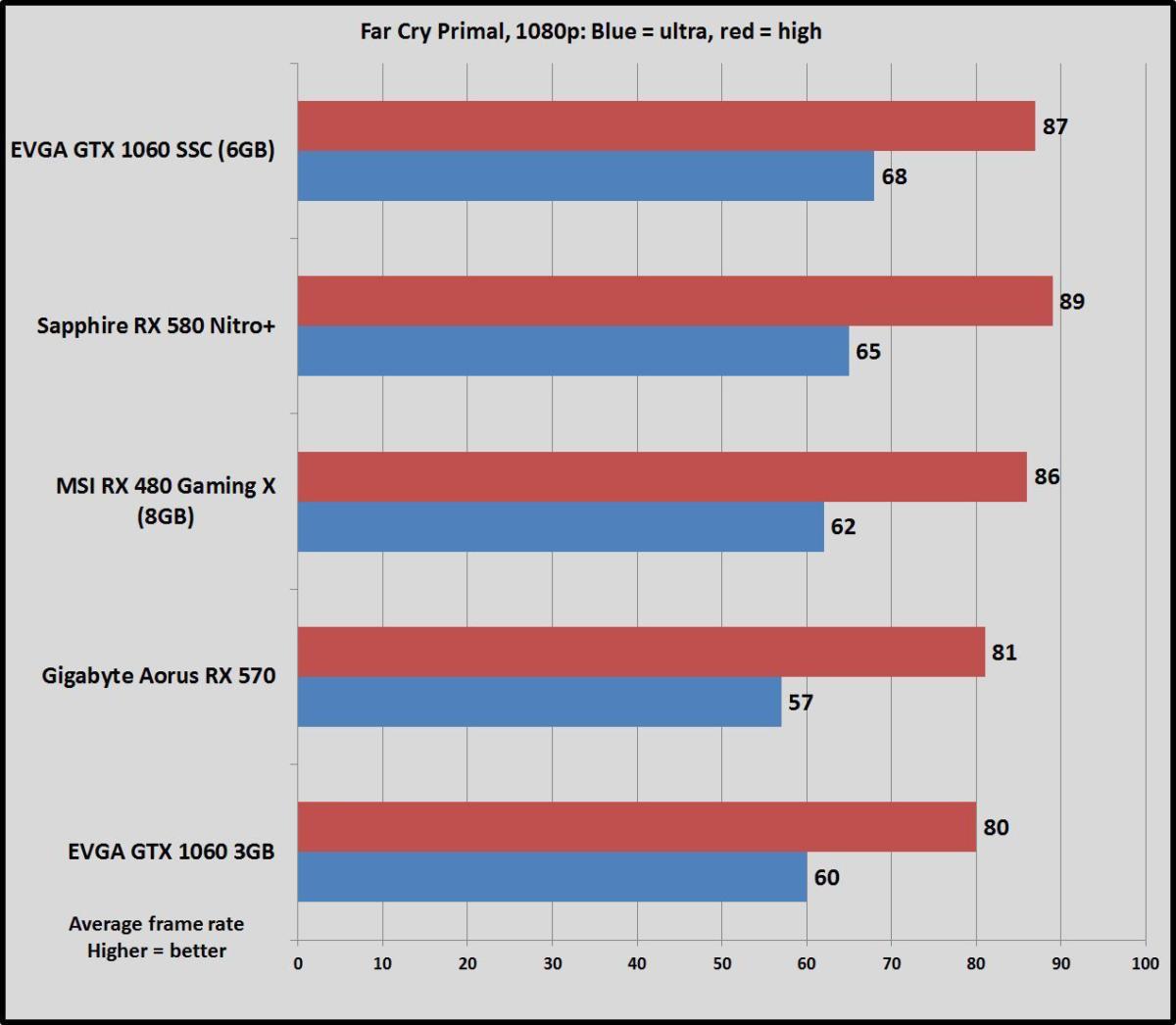
Far Weep Fundamentalis another Ubisoft game, merely information technology's powered past a dissimilar engine than The Sectionalization—the latest version of the respected Dunia engine.
 Brad Chacos/IDG
  Brad Chacos/IDG
 Once once more, the RX 580 outpunches the RX 480 by such a slim margin that your centre could never really see the departure. And in one case over again, the EVGA 6GB GTX 1060 and Sapphire RX 580 Nitro+ merchandise blows depending on the graphics preset and resolution tested.
Next folio: Ashes of the Singularity
Ashes of the Singularity
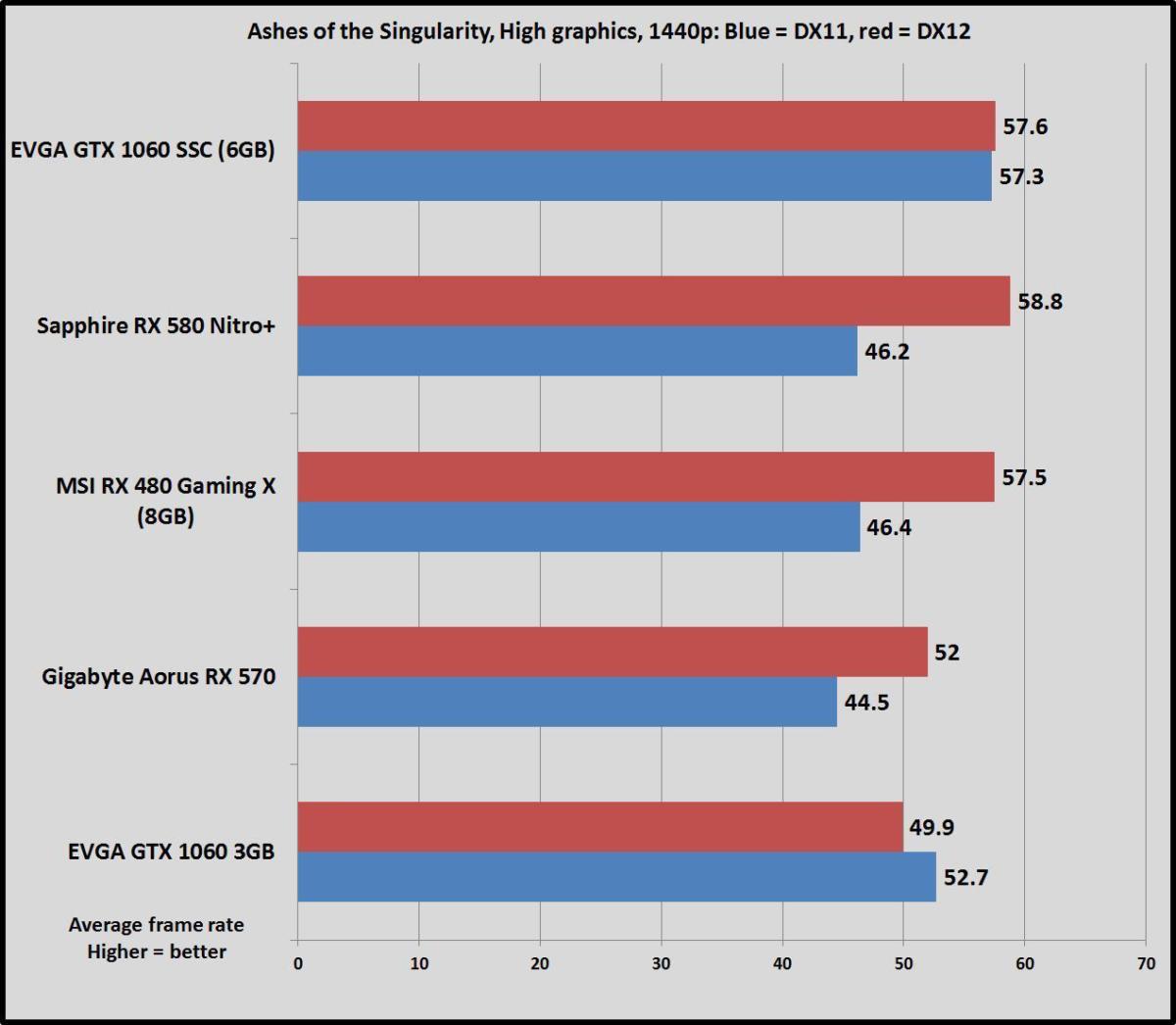
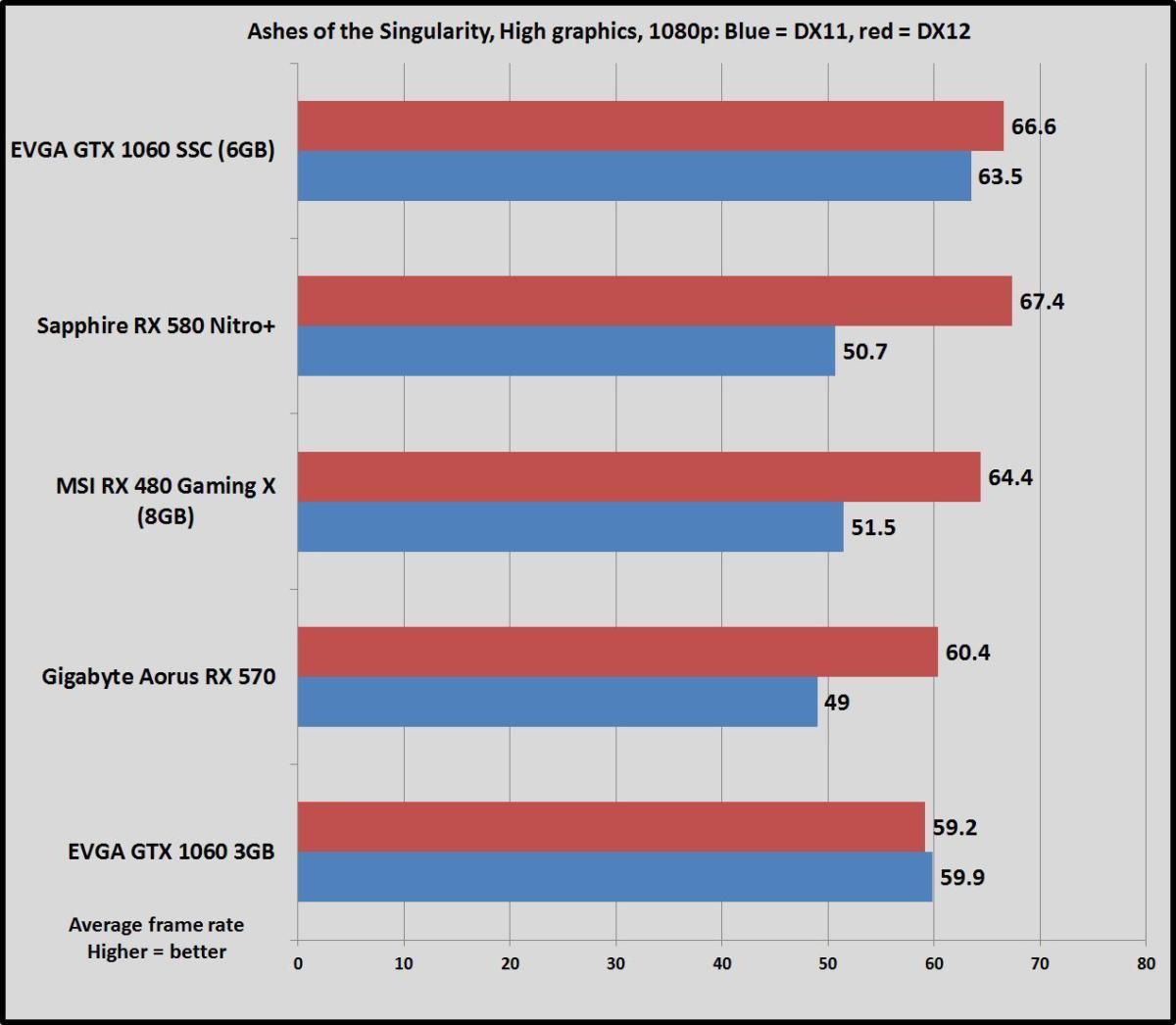
Ashes of the Singularity, running on Oxide'due south custom Nitrous engine, was an early standard-bearer for DirectX 12, and many months later on it'southstill the premier game for seeing what next-gen graphics technologies have to offer. We exam the game using the High graphics setting, equally the wildly strenuous Crazy and Extreme presets aren't cogitating of existent-world usage scenarios.
 Brad Chacos/IDG
  Brad Chacos/IDG
 Surprise! Information technology'south a draw still again—if you're on Windows x. The Radeon card only ties Nvidia'southward results if you lot enable DirectX 12, which isn't possible if you're on Windows 7 or eight.1. If you're on an older operating system, GeForce is the clear winner hither.
Next page: Synthetic benchmarks and more
Synthetics, VR, power, and heat
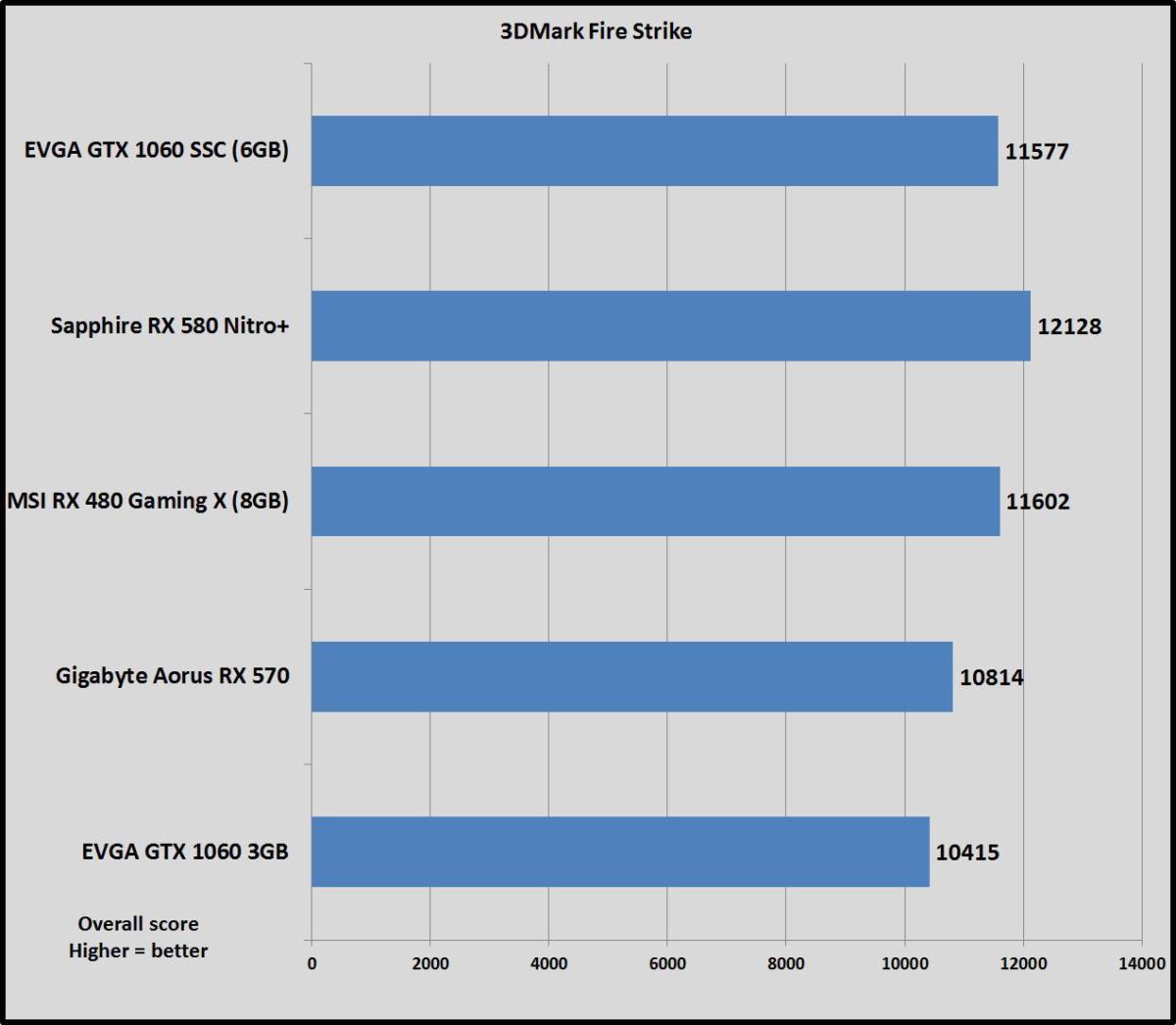
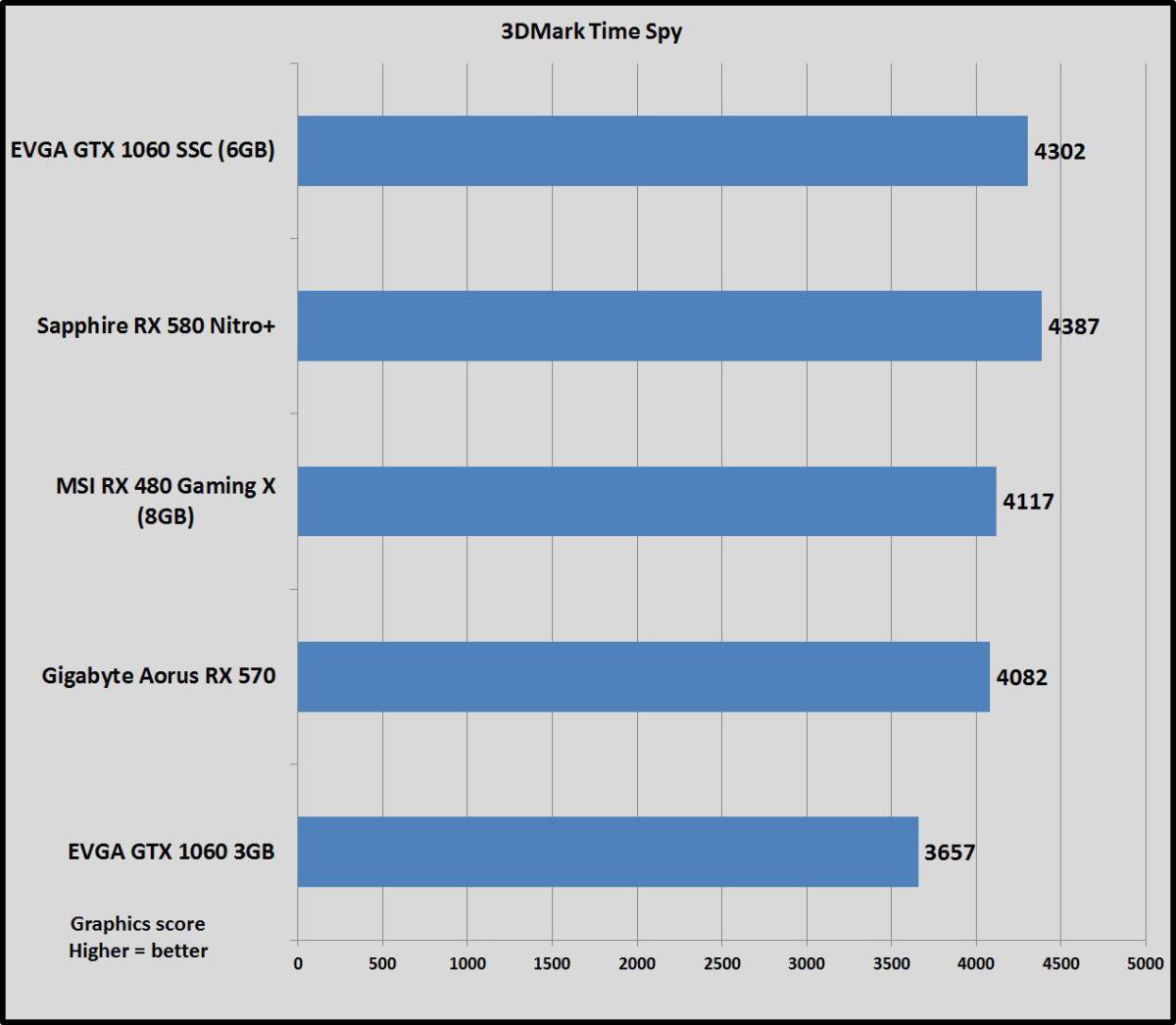
Nosotros also tested the Radeon RX 580 Nitro+ and its rivals using 3DMark's highly respected DX11 Burn down Strike and Fire Strike Ultra synthetic benchmarks, every bit well as 3DMark's Time Spy benchmark, which tests DirectX 12 performance at 2560×1440 resolution.
 Brad Chacos/IDG
  Brad Chacos/IDG
 Everything falls nearly where you'd expect based on prior performance results.
SteamVR
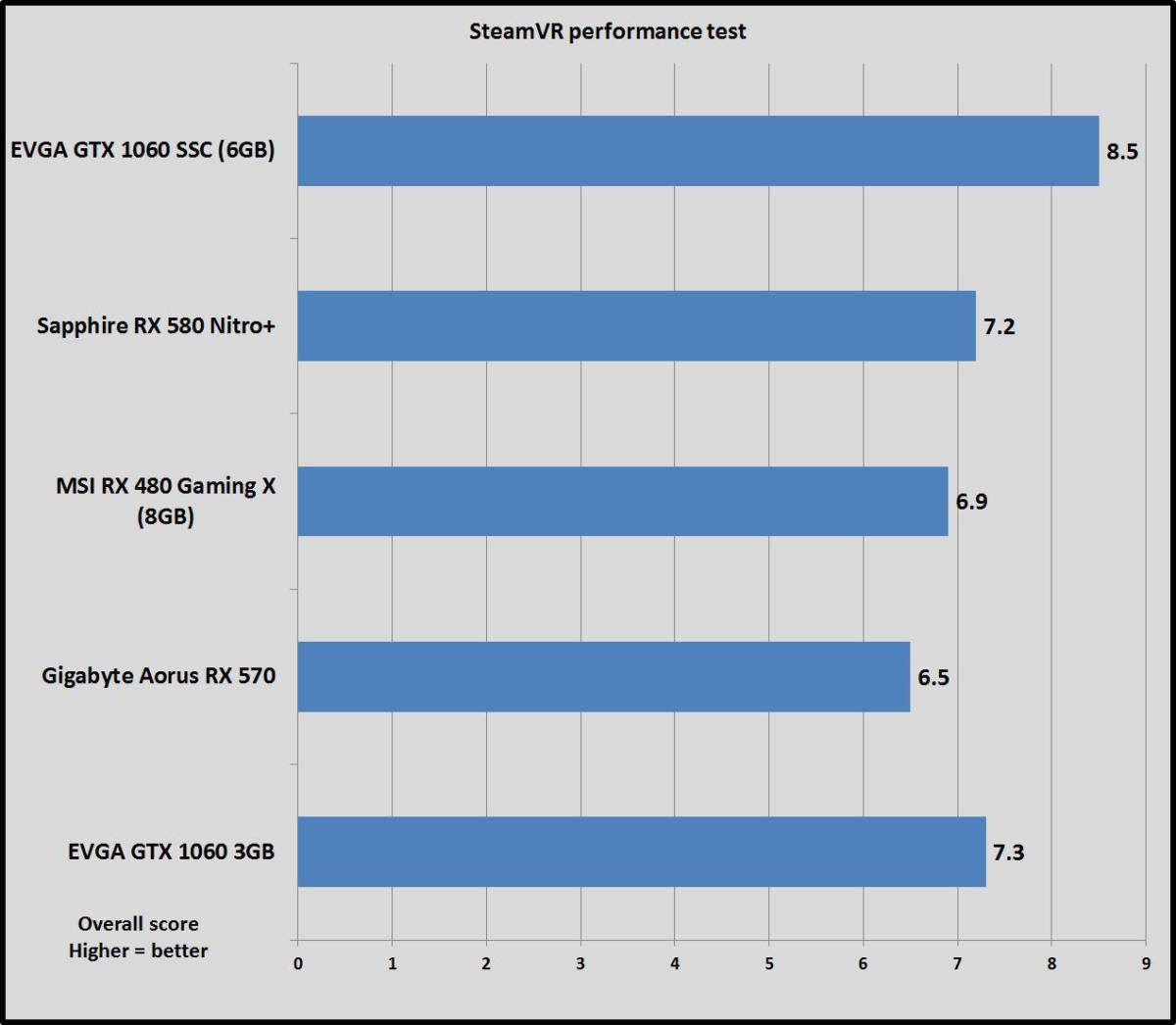
Valve'southward SteamVR functioning test considers all competitors ready for use with the HTC Vive, with the 6GB GeForce bill of fare head-and-shoulders in a higher place the rest. The Radeon RX 580 tin still deliver solid VR at a solid toll—though I'd be nervous nearly the 3GB GTX 1060's 3GB retentivity buffer, no matter what Valve's test says about its VR capabilities.
 Brad Chacos/IDG
 These cards should exercise but fine with the Oculus Rift as well, thanks in part to Oculus' amazing Asynchronous Spacewarp engineering.
Next folio: Power and oestrus
Power
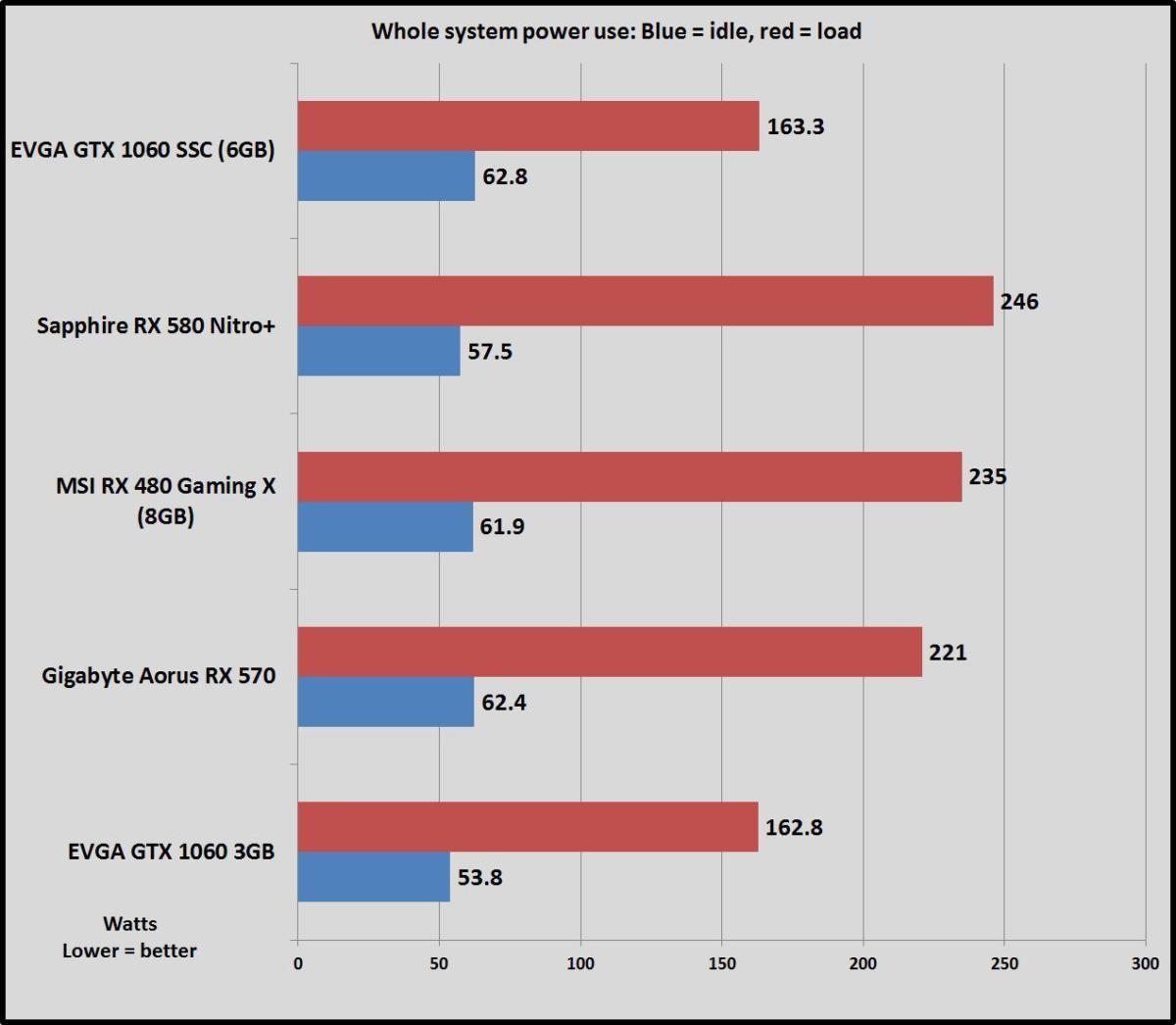
We examination power under load past plugging the entire system into a Watts Up meter, running the intensiveDivision benchmark at 4K resolution, and noting the peak power draw. Idle ability is measured subsequently sitting on the Windows desktop for 3 minutes with no extra programs or processes running.
 Brad Chacos/IDG
 No surprises hither. Nvidia's Pascal GPU architecture is still vastly more power efficient than AMD'south Polaris, and that lead's but extended now that the Radeon RX 500-series cranked up clock speeds. Both are a huge improvement over the power depict of yesteryear's graphics cards.
The power optimizations AMD promised during idle usage are reflected here every bit well. While we didn't measure it here, Radeon Chill tin can indeed bring down your power use and temperatures significantly—but only in the whitelisted games, and you lot have to manually enable it. (Which you should!)
Estrus
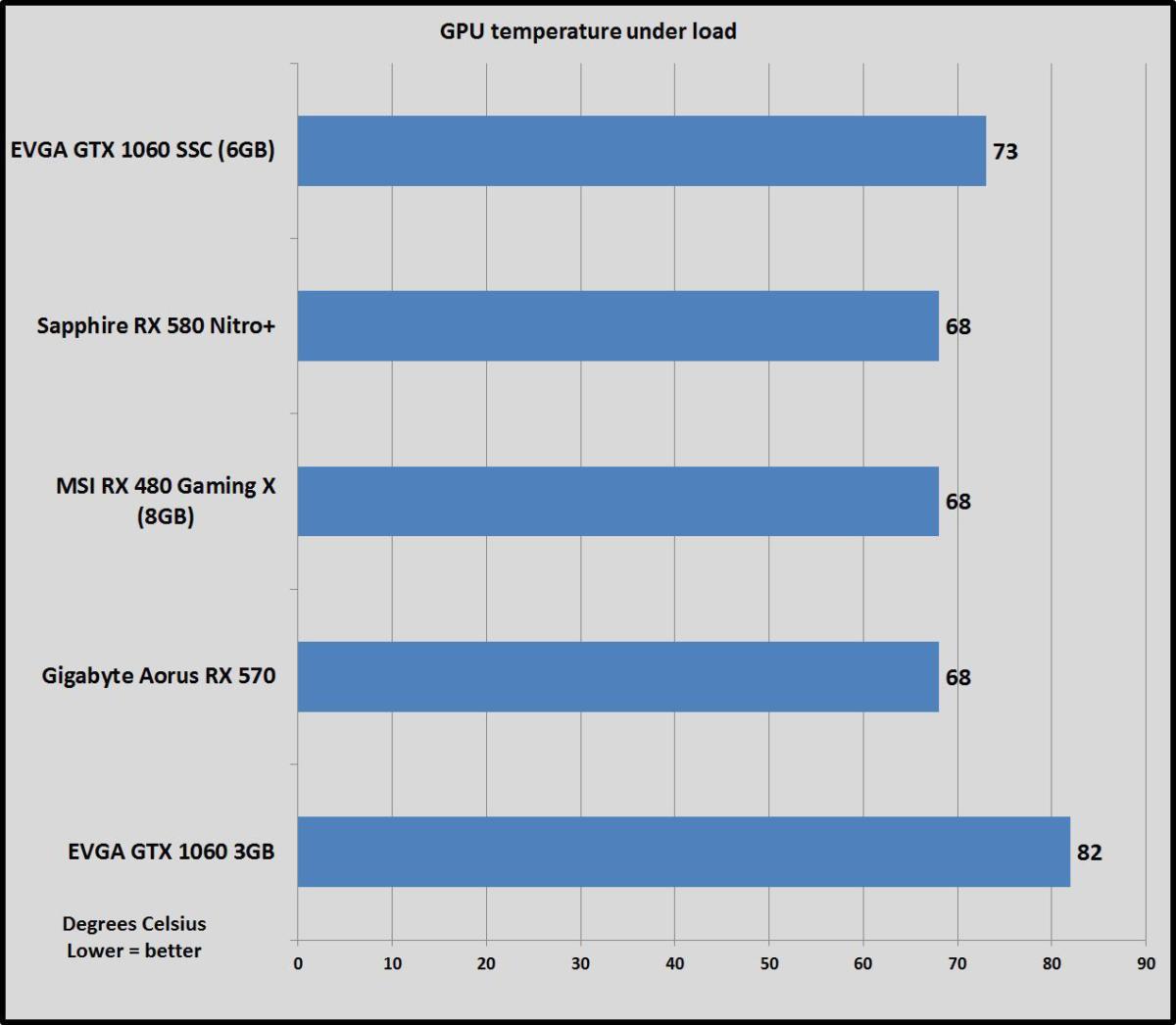
We exam heat during the same intensiveSegmentation benchmark at a strenuous 4K resolution, by running SpeedFan in the background and noting the maximum GPU temperature once the run is consummate.
 Brad Chacos/IDG
 Here's proof that the custom cooling designs by graphics carte du jour makers matter. The 6GB GeForce GTX 1060 SSC sucks down much less power than the Radeon RX 580, but Sapphire's Nitro+ keeps AMD's GPU chillier under load. It runs sliiiightly louder than the EVGA card as a result, just all the same damned quiet, fifty-fifty while gaming—and once more, Radeon Chill can piece of work wonders here if you employ information technology.
Side by side page: Bottom line
Lesser line
The Radeon RX 580 is almost a mirror image of its predecessor, and then our buying communication remains the same. Modern graphics cards built using the 14nm or 16nm manufacturing procedure deliver huge performance increases over older models from the same price segment. If you're using a Radeon R9 380 or GeForce GTX 960—or annihilation released before those—the Radeon RX 580 is a worthwhile upgrade.
The $200 4GB Radeon RX 480 is nevertheless the best mainstream graphics menu yous tin purchase today. The experiences it unlocks for that cost are nevertheless remarkable: no-compromises 60fps-plus gaming at 1080p, darn satisfying 1440p gaming in many games, and even virtual reality. This review didn't cover a 4GB RX 580, but since the new lineup hews so closely to RX 480 performance, I'1000 comfortable giving it my stamp of approving. If you're gaming at 1080p purchase this over whatever GeForce GTX 1060.
The $170 Radeon RX 570 also kicks butt at 1080p, 60fps gaming for even less money, admitting with 10 to 15 percent less performance, which makes it less futurity-proof. Pairing either the RX 570 or the RX 480 with an affordable FreeSync variable refresh monitor delivers a stellar gaming feel, and unlike Nvidia Chiliad-Sync monitors, FreeSync doesn't skyrocket the cost of a brandish. FreeSync's a major selling point for Radeon cards in this price range.
 Brad Chacos/IDG
 The $230-plus 8GB Radeon RX 580 is a trickier proffer. Information technology's most tempting if you're planning on 1440p gaming or you think the cheaper model'due south 4GB buffer won't hold upward well over the corporeality of fourth dimension you plan on keeping the graphics card. But its price signal puts the 8GB RX 580 head-to-head confronting Nvidia'due south 6GB GeForce GTX 1060 and they're nigh equals in terms of sheer performance.
Both of the cards are great, and AMD and Nvidia have both been killing it with software and drivers recently. If you value the extra 2GB of retention and affordable FreeSync monitors, go for the Radeon card. The GeForce GTX 1060 offers much better ability efficiency, Nvidia'due south wonderful Ansel tech, and typically heaven-high overclocking potential. Information technology's a button.
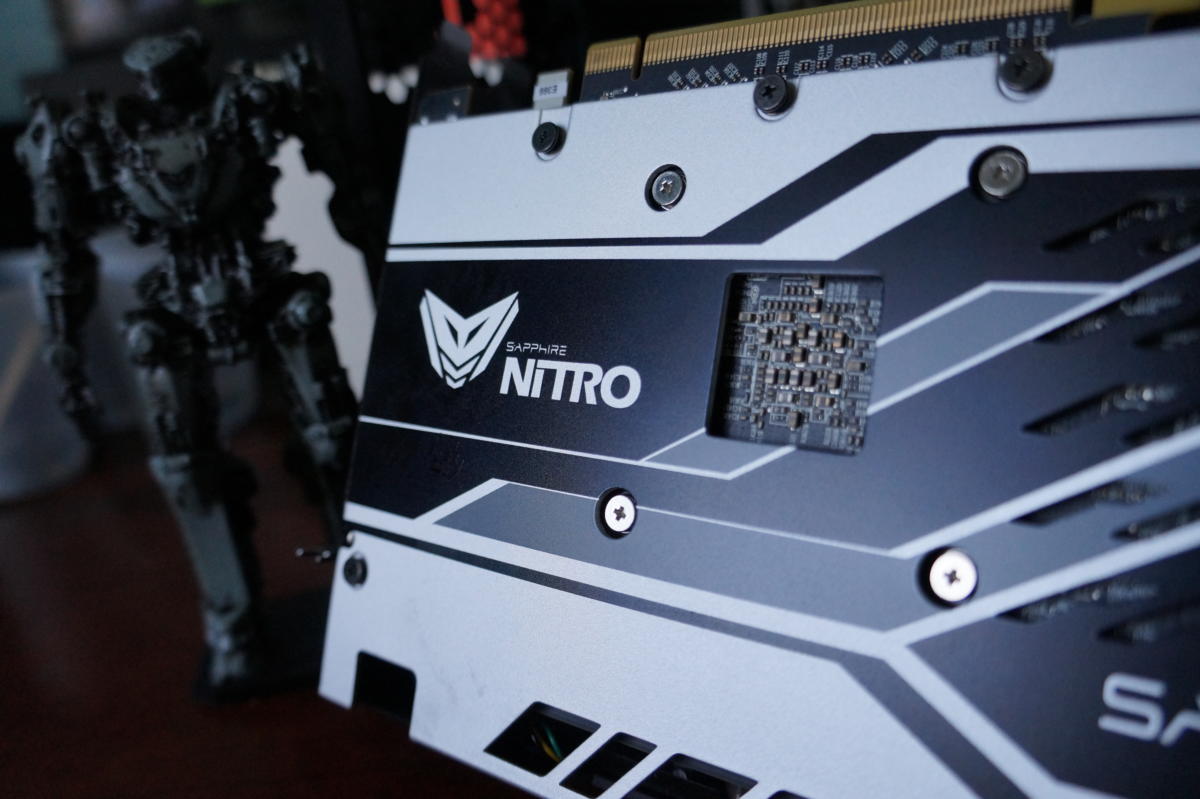
If you lot exercise decide to go with an 8GB RX 580, Sapphire's customized $250 RX 580 Nitro+ should be on your shortlist for consideration. It's gorgeous, cool, and extremely repose without being gigantic, and the extra ability connection should come up in handy if you plan on overclocking. The $250 price signal is comparable to other highly customized 8GB RX 580s existence released by other graphics card vendors, and Sapphire'south optimizations are stunning.
 Brad Chacos/IDG
 Just my communication is not to buy the Radeon RX 580 if you're reading this anytime most the carte'southward launch. As far as refreshes go, the Radeon RX 500-serial is incredibly disappointing: Retentivity speeds and capacity weren't touched whatsoever, unlike with AMD's R300-series rebrands, and the slightly higher clock speeds simply event in a performance uptick of a few frames per second. Leftover Radeon RX 480s can be found at deep price discounts as I'k writing this. On Newegg, several custom 4GB models can be had for $180, and Gigabyte's RX 480 Windforce is only $170 after rebate. Heck, several 8GB RX 480s are hovering effectually $200—including Sapphire'south own RX 480 Nitro+.
Become with the older RX 480 cards if they're available and you lot want to salvage some cash. You won't notice the performance departure. But at its core, the Radeon RX 580 is still the same Polaris GPU we're used to from before, so in one case the cheap Radeon RX 480s dry upwardly, the 4GB version of this newer refresh is still the best $200 graphics card you can buy.
Note: When you buy something subsequently clicking links in our manufactures, nosotros may earn a modest commission. Read our chapter link policy for more details.
Source: https://www.pcworld.com/article/406448/sapphire-radeon-rx-580-nitro-review-amd-battles-for-pc-gamings-sweet-spot-again.html
0 Response to "Sapphire - Radeon Rx 580 8gb Nitro+ Special Edition Video Card Review"
Post a Comment