Angels Expressed in Christian Religious Art Points of Meditation
(RNS) — Rachael Reynolds is a busy wife and mom of iii who, like many parents, suddenly has been tasked with home-schooling her children and managing the anxiety of a pandemic.
Reynolds, 34, also is a registered nurse and works three or four dark shifts a week in the labor and delivery section at a Texas hospital. That adds the stress of keeping her patients and herself safe from the spread of the novel coronavirus.
In those times when she has a few moments to herself while her kids are napping, or when she's trying to drift off to sleep as everyone else is outset a new solar day, Reynolds finds herself tapping on one of the meditation apps on her phone — similar Abide, which calls itself the No. 1 Christian meditation app to "stress less and sleep ameliorate."
"Grounding myself with the Discussion of God, and the truth and the promises he offers me in that location, I discover to be much more effective for grounding myself mentally and spiritually," she said.
RELATED:Click hither for complete coverage of COVID-19 on RNS
Meditation and mindfulness apps have boomed in the final decade, role of the trend of the twelvemonth that Apple'southward App Shop noted in 2018: self-care apps, particularly those focused on mental health.
The App Shop deemed At-home, which describes itself as the No. i app for sleep, meditation and relaxation, its 2017 app of the year.
Christian meditation apps — with names like Abide, Pray, I Minute Pause, Soultime, Soulspace and, for Catholics specifically, Hallow — have entered the scene more recently, calculation prayer and Scripture to the digital landscape of soft voices and nature sounds.
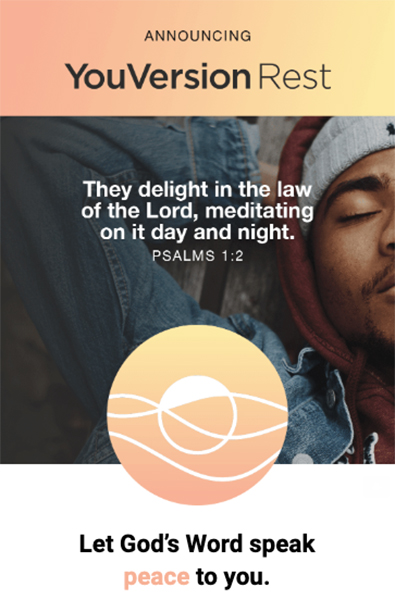
Image courtesy of YouVersion Residuum
Several of those Christian apps have reported spikes in searches for meditations on topics like anxiety since the pandemic started.
"Information technology'due south sort of actually exploding right now," said Bobby Gruenewald, pastor and innovation leader at Life.Church, one of the largest megachurches in the country.
"We definitely know that people plough to Scripture when they're in different times of need. … I remember they meet the Bible as a point of stability, truth and substance that helps them kind of center."
Life.Church's YouVersion Bible app added a YouVersion Residuum skill for smart speakers on its Bible app final calendar month, afterward noticing users were listening to Scripture tardily at night, Gruenewald said. The skill recites comforting passages from the Psalms in male or female voices over sounds like waves and raindrops.
Author and therapist John Eldredge launched a meditation and mindfulness app, Ane Infinitesimal Break, belatedly terminal year to accompany his latest book, "Get Your Life Back: Everyday Practices for a Earth Gone Mad."
As a therapist, Eldredge said, he was troubled by the ascent in feet and depression he saw even before the pandemic struck.
People were on "empathy overload" amongst news of disasters around the world. Christians — including Eldredge himself — weren't having the feel of deep rootedness expressed in the Psalms, he said.
"I got caught up in it — just the pace of life, the insanity of the hour, besides much media, also much technology, also much plugged in — and I'd come dwelling in the evenings and only find myself completely fried," he said.
"And I am a adequately monastic person, actually."
Eldredge said he began practicing a "1-infinitesimal pause" in his car at the end of each workday, taking a moment to calm down, eye himself and release everything he was feeling to God.
He started looking into building a meditation and mindfulness app years ago, he said. Secular apps similar Calm were anything but, with too many options when, he said, "what people need is a very just grounding experience in Christ" similar he had in his car.
One Minute Break offers a single, one-minute meditation, or "pause," twice a 24-hour interval read by Eldredge over a photograph of nature and soothing music. After completing a number of brusk pauses, users can movement on to longer three-, 5- or 10-minute options.
Eldredge doesn't like the word "mindfulness," he said.
He prefers to talk about giving ane's attending to God — something he said contemplative Christians like the ancient desert fathers or Julian of Norwich (she of the popular mantra, "All shall be well and all shall be well and all mode of things shall exist well") have practiced for centuries.
"It's an aboriginal Christian practise, but we need help dorsum to it considering our attending has been shattered," he said.
Bide has been around nigh five years, since 2 onetime Google employees who were Christians decided to exit the tech giant and utilize their skills instead "for the kingdom," co-ordinate to Russ Jones, its executive producer of content.
Image courtesy of Bide
The app started out more like Instagram, Jones said, inviting users to create and share their ain prayers. But it really took off once it started providing those prayers. Now, an average 100,000 people download Abide for the first time each month from Apple and Android stores, he said.
Bide offers users a daily meditation and a library of prayers on dissimilar topics — most popularly, worry and feet. Users can choose the length of each meditation and the images and sounds that accompany information technology.
In recent weeks, the app has added a number of healing prayers, too, including a 12-minute coronavirus healing prayer asking God "that those who take the virus will be healed and that its spread would dull and that it would shortly exist eradicated."
Only an app is no replacement for a church, Jones said.
"People need to be in a local body," even if that'south meeting from a safe distance through the electric current pandemic, he said.
"We are that place that people can go in the night dark of the soul at 2 o'clock in the forenoon when the pastor is not bachelor in churches, open. We're that identify where people tin can continue the run in their decorated lives and nonetheless be in Scripture."
Another app, Pray, launched in 2017 with a vision to become "the digital destination for faith," according to creator Steve Gatena.
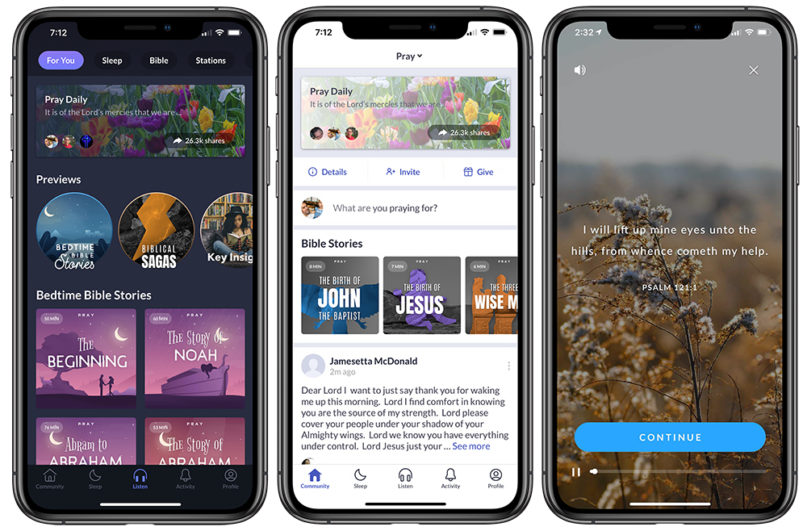
Screenshots of the Pray app. Images courtesy of Pray
Since adding subscription content to the app final yr — similar bedtime stories scripted from Scripture and biblical meditations — information technology's get the fastest growing religious subscription service in the world, he said.
Amid the pandemic, Pray is offering those meditations for gratuitous, also as content for kids who now are dwelling house from school and other services for churches that suddenly find themselves meeting online. And it'south seeing a rising in the minutes users spend listening to the app and in new subscribers, according to Gatena.
"With stress levels climbing by the solar day, we believe everyone deserves access to programs that aid reduce feet levels," he said.
That'southward one of the benefits of meditation, he said. It tin can help users think more conspicuously, better handle stressful situations and — in the instance of Christian meditation — reflect on the give-and-take of God.
Pray's meditations always start with Scripture, Gatena said. And so they move through the popular framework for prayer that follows the acrostic "ACTS": Adoration, Confession, Thanksgiving and Supplication.
Merely, he said, he knows the discussion "meditation" tin can raise eyebrows for Christians.
Some evangelical Christians have fretted that practices like meditation and mindfulness aren't Christian, just rather New Age or Buddhist.
Some Buddhists take been critical of the app craze, too, noted Sarah Shaw, an Oxford lecturer and skilful on Buddhist history who traces the history of mindfulness in her upcoming volume "Mindfulness: Where It Comes From and What It Means."
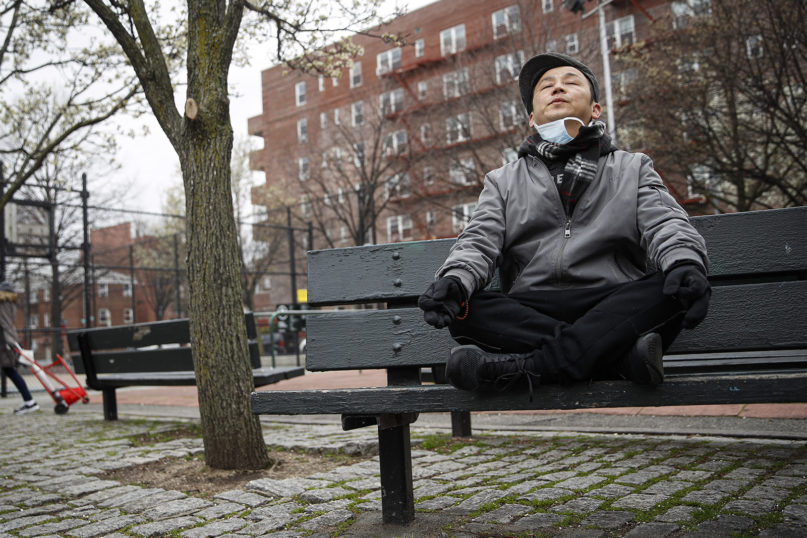
Lobsang Tseten meditates and practices breathing exercises alone to maintain social distancing at a playground, Wed, March 25, 2020, in New York. (AP Photograph/John Minchillo)
The "new moving ridge" of mindfulness and meditation does come up from Buddhism, according to Shaw.
Jon Kabat-Zinn, who introduced the thought of mindfulness every bit therapy, had prior feel with Buddhism, she said. And Andy Puddicombe, co-founder of Headspace and an ordained Buddhist monk, launched the app on a mission to bring the training he'd received to the masses.
But, she said of mindfulness, "I don't think anybody owns this give-and-take."
Many religions have different aspects of meditation and mindfulness — even if it doesn't look the aforementioned across traditions or if they don't use the same words for information technology, according to Shaw.
In Christianity, she said, St. Augustine wrote almost "recollection in everyday life and being aware of God in every moment." And there'southward biblical precedent, likewise: The scholar pointed to Psalm 8:iv, which asks, "What is human being, that thou art mindful of him?"
In fact, the term "mindfulness" was first introduced to the English language in the fourteenth century Wycliffe Bible, she said.
It'due south something Shaw believes tin deepen the practice of anyone'south religion.
"If yous're mindful of your body and breath, you can't be worried at the aforementioned time. … Yous become more than alert to yourself, and you will and so inevitably get more mindful and aware of other people, and, of course, we're all having to be mindful of everybody at the moment," she said.
"I think information technology'south going to be interesting that people will learn how to detect peace and happiness in their ain visitor. And I hope it might really bring about a spiritual revival."

Photograph courtesy of Pixabay/Creative Commons
Reynolds, the nurse, has heard the arguments from other evangelical Christians that meditation is too secular or taken from Eastern religions — certainly not something a "Bible-believing Christian" should do.
"I think information technology's interesting that there's withal pushback from people who know Scripture because you lot see it all throughout the Psalms. David talks about, 'I meditate on your word day and night,'" she said.
Compared to previous generations, millennials like herself seem "more open and willing to see how mental wellness and emotional wellness really ties into us every bit beings holistically," she said.
"I actually love that people are now learning that the God who created u.s. physically also created the spiritual and emotional and mental sides of us, and those deserve to exist fed and treated well, just similar we would with eating correct and exercising our physical bodies."
Reynolds downloaded the Abide app about a twelvemonth ago afterward she experienced meditation and guided Scripture readings at a retreat she attended with her husband. She has used it several times a calendar week — fifty-fifty more since the coronavirus began its march across the U.S.
She particularly likes the meditations on the app that are pulled from Scripture, she said.
To her, they bring together concrete, mental and spiritual health. Like other meditation apps, she said, they decrease the stress she feels, slow her thoughts and help her sleep improve. They also keep her centered and grounded in Scripture and in what she believes to be true about God.
"For me, it was something that was important to keep myself grounded in the truth of God's give-and-take and an easy way to do that. And I have plant it to be actually, actually beneficial."
Source: https://religionnews.com/2020/04/15/theres-an-app-for-that-christian-mindfulness-and-meditation-apps-find-moment-in-midst-of-pandemic/
0 Response to "Angels Expressed in Christian Religious Art Points of Meditation"
Post a Comment